Make It Sound Like Me
Why A.I. Will Never Replace Writers

Creativity that resonates stems from art made by humans for other humans.
One of the habits of being a lifelong gamer is the curiosity to test the limitations of any given system. Part of the fun of playing a new video game is in finding out which mechanics excel, where the boundaries are, and if any exploits can break the game to either give you an advantage or reveal the shortcomings of a game’s design.
With the explosion of A.I. language models like ChatGPT, Claude, Grok, and Gemini, I’ve been curious about A.I.’s role in the future of creative writing. Since technology grows exponentially, one of my micro-anxieties as a writer is this fear that in a decade, language models will be competent enough to render creative writing obsolete.
After several months of testing the limitations of several language models, I’m happy to report that human writers are here to stay. It’s not even a legitimate concern any writer should have. There are two issues with generative A.I. that are fundamental at the most human level, and not something easily programmable given enough time.
The first issue is best summed up by one recurring meme and popular comment I see whenever someone online parodies one of these language models. It speaks to one of the core fundamental problems with generative A.I.’s design.
“Make it sound like me.”
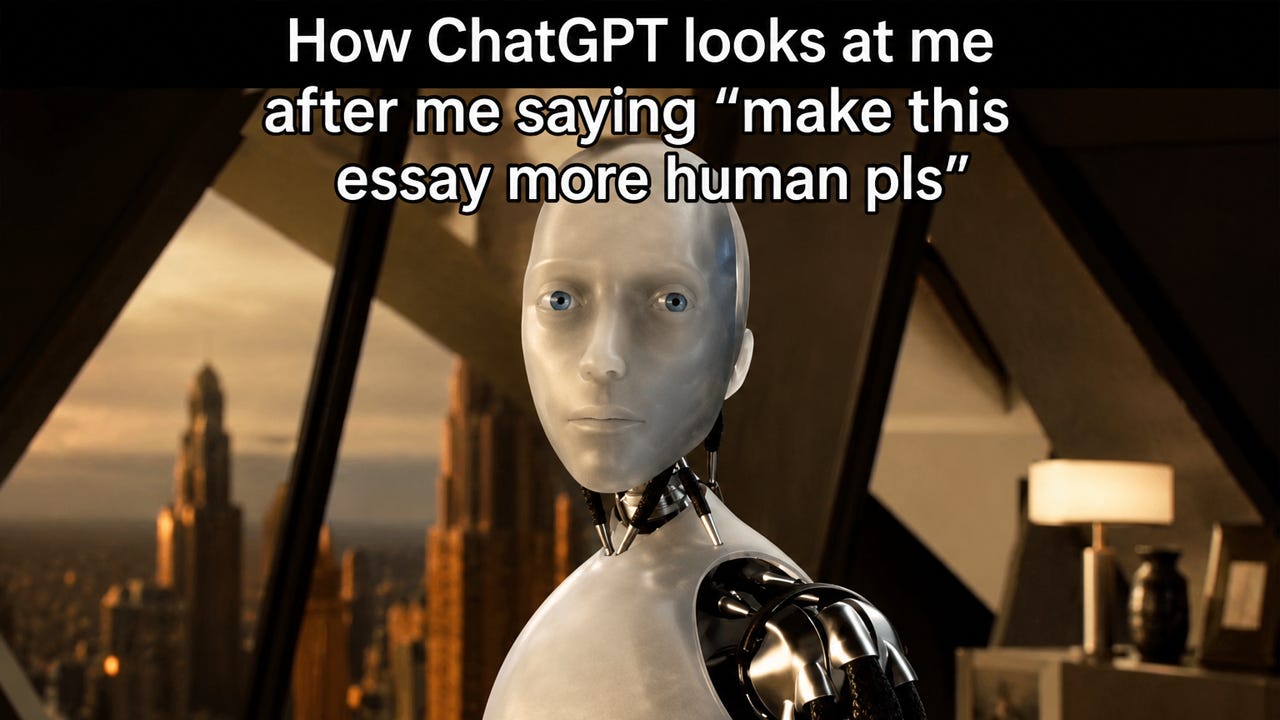
If you’ve ever used any language model to condense a long-winded email, you’ve probably had to write a version of this command prompt. That’s because language models are better at robbing you of your voice and replacing it with a baseline than being a convenient editor. At best, they are a weak imitation of the human using them.
For my YouTube channel The Writest, where I analyze story structure in video games, one of my limitation tests was to see if generative A.I. could write a script based on a solid sampling of my existing writing on the channel and an outline for an essay. In a perfect world, it should create a skeleton draft that I could then rewrite myself.
It failed this basic task spectacularly.
Effective tools eliminate mundane tasks. Since so much of my time is spent writing and producing comics, it’s tough to find time to produce a video essay from script to final post. A.I. cutting out the preliminary stage of one of my extracurricular writing activities would make it an effective tool. Test one was more trouble than it was worth.
It was able to loosely copy my general cadence, but it didn’t have my editor’s eye for refinement. It threw out clunky word choices I would never use. Syntax was nothing like me at all. I spent a frustrated ten minutes rewriting so much of what was generated that it felt easier to scrap everything and write the essay from scratch.
Inventions that remove trivial inconvenience are helpful. Inventions that add inconvenience are not ready for prime time.

Creative writing has a jazz quality to it. A.I. works on a fixed set of rules. It doesn’t know when to utilize a set of rules to strengthen a piece of writing and when to break them. Despite the confident tone with which A.I. speaks to you, there are numerous holes in its logic that you can easily reveal with even a modicum of critical thinking.
A.I. doesn’t consider personal taste. When I asked it to give me feedback on a Haiku, I learned that, for it to be an effective literary critic, it needed to be told how to critique poetry. Its initial feedback was purely analytical when reviewing the quality of the writing. Its feedback was slightly better than asking Fido what he thinks.
Personal taste is a key component not just in shaping a writer’s voice, but how other humans interpret that writing. A.I. is an amalgam of information pulled from the internet. It never decides what it personally thinks is valuable. That level of nuanced discernment is still something only a human can achieve.
This leads me to the second fundamental reason A.I. won’t replace writers, and this also applies to any creative person - lived experiences.
Art is self-expression. The experiences you’ve had, from the creators who inspire you, to the movies you watch, to your own personal habits creates a unique perspective that’s not easily replicated. The only way for A.I. to be a more unique version than you, is to BE you. Without your sensibilities, it will always be an imitation.
The “make it sound like me” meme speaks to the heart of this idea. If we’re using language models to replicate our unique voice, doesn’t that mean the human voice is definitive? One of the smartest robots in the world can beat a human at chess, but it can’t do anything else. The human brain is still our most versatile piece of technology.
Originality beats imitation. Hollywood reboots rarely perform well at the box office because they’re an imitation of something original that came before it. As long as language models are devoid of true originality, pop culture will always gravitate towards a unique human creation. That can’t be replaced overnight.
Every now and again, some A.I. slop on social media will be genuinely entertaining. In those instances, it’s because the creators injected so much of their own original vision under the hood that it started to deviate away from mindless content. It’s the human component that turns something mindless into something memorable.
Creativity that resonates stems from art made by humans for other humans. When you remove that crucial component, the results become shallow and one dimensional. If pop culture spent most of its time giving money to reboots and A.I. slop, human creativity might be in jeopardy. The opposite seems to be true.
Generative A.I.’s has its uses. None of them can turn a mediocre writer into a great one. Its most reliable use for a writer is in low-stakes optimization. If I feed a language model 29 writing books I’ve read, it’s effective at suggesting what number 30 should be. It’s helpful at streamlining basic internet searches, but not much else.
There’s plenty more to be said about A.I. and creativity. Todd McFarlane just recently inspired a completely different substack I plan to write in the future. For now, my attention lies in a language model’s ability to make creative writing obsolete. It seems like a lower bar to cross than eliminating a professional artist.
After field testing, that lower bar is still incredibly high for A.I to surpass. Human writers are not easily replaceable given our versatile minds and unique perspectives. A.I. has potential in helping with preliminary writing, but it has a long road ahead before it can be safely used as a reliable tool that can trim the trivial fat of creation.
The human component of creativity can’t be easily replaced by A.I. If it were, users wouldn't be so desperate to make generative A.I. feel human.
Until next time. Stay cool!
- Tony James